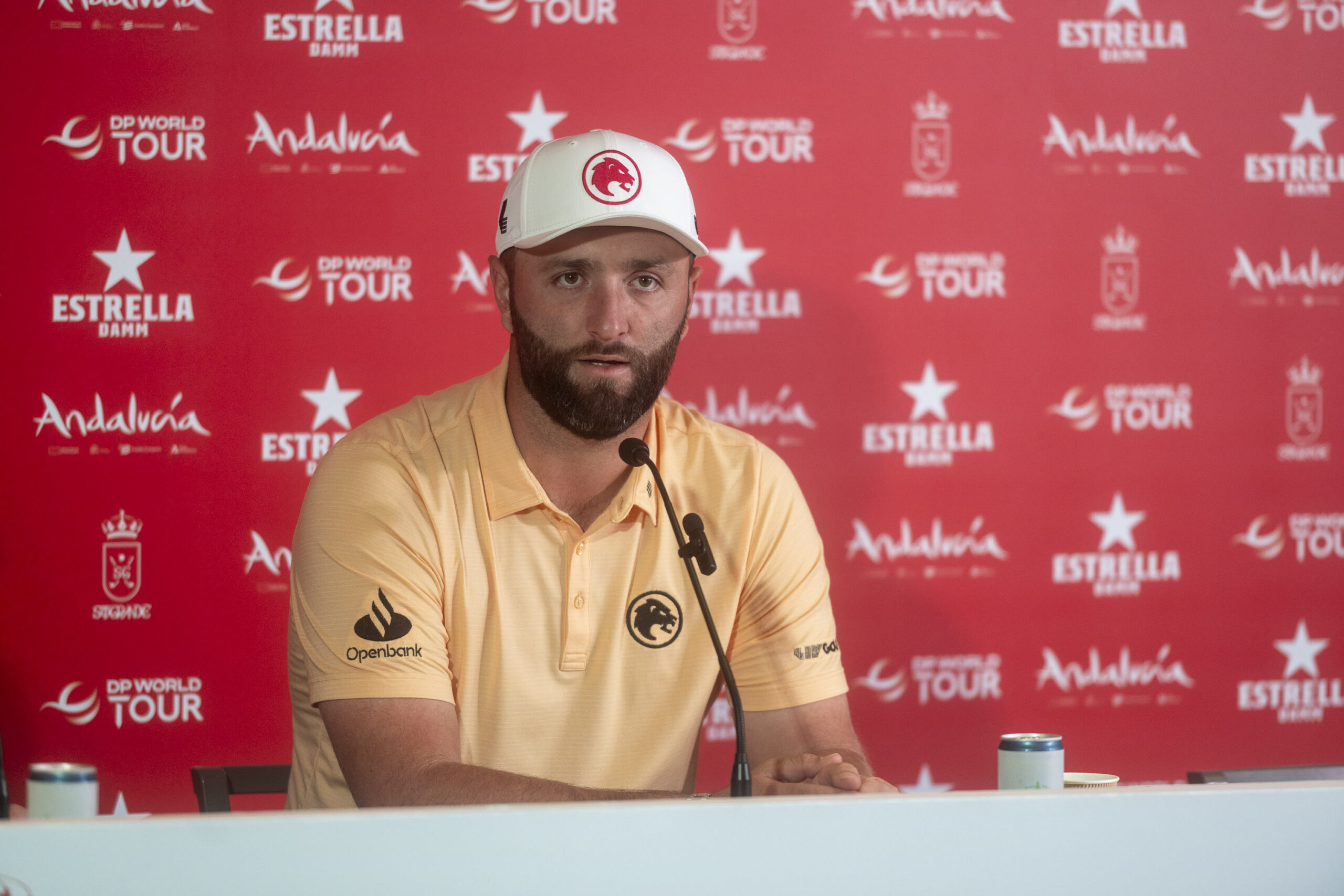
El golfista vasco, con dos Grandes y 10 victorias del DP World Tour en su palmarés, sufrió una dolosa derrota en la Copa Sotogrande 2012. Era la primera vez que tenía a tiro un torneo importante y se le escapó.
“En el tee del 12 iba cuatro o cinco menos en el día y ganando por cuatro o cinco. No me acuerdo muy bien si me relajé o me puse demasiado nervioso. La mandé a la izquierda, hice doble bogey o bogey en el 13, birdie en el 14, bogey en el 15 y tres pats en el 17, creo que para otro bogey. En el 18 aún tenía un pat de unos cinco metros para birdie y ganar, y no se me olvidará en la vida porque la dejé corta por el centro a medio centímetro del hoyo. Luego, perdí el play-off en el hoyo uno”.
“Ese domingo no lo voy a olvidar, pero los momentos malos son necesarios para aprender y desarrollarse como jugador. Grandes campeones como Mickelson o Tiger son capaces de contarte golpes que hicieron hace 35 años con todo detalle, han llegado al nivel que han llegado porque aprendieron mucho de sus errores”.
Pese a todo, Rahm guarda excelentes recuerdos de Sotogrande y Andalucía.
“La hospitalidad de aquí es increíble y del campo nunca he oído nada negativo, eso quiere decir que es muy especial”.
El jugador vasco sueña con ofrecer un buen espectáculo a los aficionados españoles, y conseguir un título que se le ha resistido en las tres ocasiones en las que ha jugado el Estrella Damm N.A. Andalucía Masters. Su mejor resultado fue un segundo puesto empatado en la edición de 2019.
“Jugar en España es especial y divertido, quizá más duro mentalmente porque tienes más ganas de hacerlo bien, pero esa tensión ha hecho que viva domingos muy buenos como los de las victorias en los Open de España de 2018, 2019 y 2022 e incluso el último Open, aunque no gané, fue muy emotivo para Ángel Hidalgo”.
Tras una semana de descanso, llega al RCG Sotogrande con las pilas cargadas.
“Los niños tenían vacaciones así que he ejercido más de padre que de otra cosa y me he divertido mucho. Mentalmente he descansado muchísimo y he venido con muchas ganas a este último torneo de este año en España”.
A punto de cumplir 30 años, Jon Rahm hace balance y no cree que todos los acontecimientos que ha vivido en el golf le hayan cambiado mucho.
“Cada día aprendes algo nuevo y tienes nuevas experiencias, pero mi esencia como persona no me ha cambiado. Yo creo que el ir a los 15 años de una ikastola en Euskadi, en Bilbao, a estudiar a Madrid, para mí fue un cambio muy grande. Simplemente, el cambio de estudiar en español fue muy difícil. Luego de ahí a Estados Unidos. Yo creo que esos dos cambios fueron más grandes que lo que me ha pasado de profesional hasta ahora”.
Pese a reconocer que, en esencia, sigue siendo el mismo, sí se muestra más cauto que aquel chico de 17 años que, rebosante de confianza, aseguró que ganaría 19 Grandes.
“Entiendo que fui prepotente, pero mi actitud es la misma; si no te lo crees tú, no se lo va a creer nadie; si yo no tengo ese objetivo y ese sueño no llego a donde estoy. Sé que, si no tengo un objetivo suficientemente grande, no voy a dar el máximo esfuerzo para llegar a él”.
“Ahora que tengo dos Grandes mi objetivo es llegar a tres, si algún día tengo tres, será llegar a cuatro, si me quedo a mitad de camino de los 19 y llego a nueve o diez, será una carrera increíble. Hoy en día, pasar de 5 es muy difícil”.
Aunque Rahm es el mejor español del ranking mundial, en el puesto decimocuarto, hay otros 16 españoles deseando que el título se quede en casa. Hoy se han hecho la tradicional foto de familia junto a la casa club.
Las opciones españolas pasan también por Pablo Larrazábal, Álvaro Quirós, Adrián Otaegui, Rafa Cabrera Bello, Jorge Campillo, Nacho Elvira, Adri Arnaus, Ángel Hidalgo, Alfredo García Heredia, David Puig, Eugenio Chacarra, Santiago Tarrío, Alejandro del Rey, Manuel Elvira, Iván Cantero y Sebastián García.
Este modo permite a las personas con epilepsia utilizar el sitio web de forma segura al eliminar el riesgo de convulsiones que resultan de las animaciones intermitentes o parpadeantes y las combinaciones de colores arriesgadas.
Modo para personas con discapacidad visual
Mejora las imágenes del sitio web.
Este modo ajusta el sitio web para la comodidad de los usuarios con discapacidades visuales, como visión degradada, visión de túnel, cataratas, glaucoma y otras.
Modo de discapacidad cognitiva
Ayuda a concentrarse en contenido específico.
Este modo brinda diferentes opciones de asistencia para ayudar a los usuarios con deficiencias cognitivas, como dislexia, autismo, CVA y otras, a concentrarse más fácilmente en los elementos esenciales del sitio web.
Modo compatible con TDAH
Reduce las distracciones y mejora el enfoque.
Este modo ayuda a los usuarios con TDAH y trastornos del desarrollo neurológico a leer, navegar y concentrarse en los elementos principales del sitio web con mayor facilidad, al tiempo que reduce significativamente las distracciones.
Modo de ceguera
Permite usar el sitio con su lector de pantalla
Este modo configura el sitio web para que sea compatible con lectores de pantalla como JAWS, NVDA, VoiceOver y TalkBack. Un lector de pantalla es un software para usuarios ciegos que se instala en una computadora y un teléfono inteligente, y los sitios web deben ser compatibles con él.
Diccionario en línea
Experiencia legible
Escalado de contenido
Por defecto
Lupa de texto
Fuente legible
Apto para dislexia
Destacar títulos
Destacar enlaces
Tamaño de fuente
Por defecto
Altura de la línea
Por defecto
Espaciado de letras
Por defecto
Alineado a la izquierda
Centro alineado
Alineado a la derecha
Experiencia visualmente agradable
Contraste oscuro
Contraste de luz
Monocromo
Alto contraste
Alta saturación
Baja saturación
Ajustar colores de texto
Ajustar los colores del título
Ajustar los colores de fondo
Orientación Fácil
Silenciar sonidos
Ocultar imágenes
Ocultar emoji
Guía de lectura
Detener animaciones
Máscara de lectura
Resaltar pasar el cursor
Resalte el enfoque
Gran cursor oscuro
Cursor de luz grande
Lectura cognitiva
Teclado virtual
Teclas de navegación
Navegación por voz
Accessibility Statement
www.merchanendirecto.es
14/12/2025
Compliance status
We firmly believe that the internet should be available and accessible to anyone, and are committed to providing a website that is accessible to the widest possible audience, regardless of circumstance and ability.
To fulfill this, we aim to adhere as strictly as possible to the World Wide Web Consortium’s (W3C) Web Content Accessibility Guidelines 2.1 (WCAG 2.1) at the AA level. These guidelines explain how to make web content accessible to people with a wide array of disabilities. Complying with those guidelines helps us ensure that the website is accessible to all people: blind people, people with motor impairments, visual impairment, cognitive disabilities, and more.
This website utilizes various technologies that are meant to make it as accessible as possible at all times. We utilize an accessibility interface that allows persons with specific disabilities to adjust the website’s UI (user interface) and design it to their personal needs.
Additionally, the website utilizes an AI-based application that runs in the background and optimizes its accessibility level constantly. This application remediates the website’s HTML, adapts Its functionality and behavior for screen-readers used by the blind users, and for keyboard functions used by individuals with motor impairments.
If you’ve found a malfunction or have ideas for improvement, we’ll be happy to hear from you. You can reach out to the website’s operators by using the following email
Screen-reader and keyboard navigation
Our website implements the ARIA attributes (Accessible Rich Internet Applications) technique, alongside various different behavioral changes, to ensure blind users visiting with screen-readers are able to read, comprehend, and enjoy the website’s functions. As soon as a user with a screen-reader enters your site, they immediately receive a prompt to enter the Screen-Reader Profile so they can browse and operate your site effectively. Here’s how our website covers some of the most important screen-reader requirements, alongside console screenshots of code examples:
Screen-reader optimization: we run a background process that learns the website’s components from top to bottom, to ensure ongoing compliance even when updating the website. In this process, we provide screen-readers with meaningful data using the ARIA set of attributes. For example, we provide accurate form labels; descriptions for actionable icons (social media icons, search icons, cart icons, etc.); validation guidance for form inputs; element roles such as buttons, menus, modal dialogues (popups), and others. Additionally, the background process scans all the website’s images and provides an accurate and meaningful image-object-recognition-based description as an ALT (alternate text) tag for images that are not described. It will also extract texts that are embedded within the image, using an OCR (optical character recognition) technology. To turn on screen-reader adjustments at any time, users need only to press the Alt+1 keyboard combination. Screen-reader users also get automatic announcements to turn the Screen-reader mode on as soon as they enter the website.
These adjustments are compatible with all popular screen readers, including JAWS and NVDA.
Keyboard navigation optimization: The background process also adjusts the website’s HTML, and adds various behaviors using JavaScript code to make the website operable by the keyboard. This includes the ability to navigate the website using the Tab and Shift+Tab keys, operate dropdowns with the arrow keys, close them with Esc, trigger buttons and links using the Enter key, navigate between radio and checkbox elements using the arrow keys, and fill them in with the Spacebar or Enter key.Additionally, keyboard users will find quick-navigation and content-skip menus, available at any time by clicking Alt+1, or as the first elements of the site while navigating with the keyboard. The background process also handles triggered popups by moving the keyboard focus towards them as soon as they appear, and not allow the focus drift outside it.
Users can also use shortcuts such as “M” (menus), “H” (headings), “F” (forms), “B” (buttons), and “G” (graphics) to jump to specific elements.
Disability profiles supported in our website
Epilepsy Safe Mode: this profile enables people with epilepsy to use the website safely by eliminating the risk of seizures that result from flashing or blinking animations and risky color combinations.
Visually Impaired Mode: this mode adjusts the website for the convenience of users with visual impairments such as Degrading Eyesight, Tunnel Vision, Cataract, Glaucoma, and others.
Cognitive Disability Mode: this mode provides different assistive options to help users with cognitive impairments such as Dyslexia, Autism, CVA, and others, to focus on the essential elements of the website more easily.
ADHD Friendly Mode: this mode helps users with ADHD and Neurodevelopmental disorders to read, browse, and focus on the main website elements more easily while significantly reducing distractions.
Blindness Mode: this mode configures the website to be compatible with screen-readers such as JAWS, NVDA, VoiceOver, and TalkBack. A screen-reader is software for blind users that is installed on a computer and smartphone, and websites must be compatible with it.
Keyboard Navigation Profile (Motor-Impaired): this profile enables motor-impaired persons to operate the website using the keyboard Tab, Shift+Tab, and the Enter keys. Users can also use shortcuts such as “M” (menus), “H” (headings), “F” (forms), “B” (buttons), and “G” (graphics) to jump to specific elements.
Additional UI, design, and readability adjustments
Font adjustments – users, can increase and decrease its size, change its family (type), adjust the spacing, alignment, line height, and more.
Color adjustments – users can select various color contrast profiles such as light, dark, inverted, and monochrome. Additionally, users can swap color schemes of titles, texts, and backgrounds, with over seven different coloring options.
Animations – person with epilepsy can stop all running animations with the click of a button. Animations controlled by the interface include videos, GIFs, and CSS flashing transitions.
Content highlighting – users can choose to emphasize important elements such as links and titles. They can also choose to highlight focused or hovered elements only.
Audio muting – users with hearing devices may experience headaches or other issues due to automatic audio playing. This option lets users mute the entire website instantly.
Cognitive disorders – we utilize a search engine that is linked to Wikipedia and Wiktionary, allowing people with cognitive disorders to decipher meanings of phrases, initials, slang, and others.
Additional functions – we provide users the option to change cursor color and size, use a printing mode, enable a virtual keyboard, and many other functions.
Browser and assistive technology compatibility
We aim to support the widest array of browsers and assistive technologies as possible, so our users can choose the best fitting tools for them, with as few limitations as possible. Therefore, we have worked very hard to be able to support all major systems that comprise over 95% of the user market share including Google Chrome, Mozilla Firefox, Apple Safari, Opera and Microsoft Edge, JAWS and NVDA (screen readers).
Notes, comments, and feedback
Despite our very best efforts to allow anybody to adjust the website to their needs. There may still be pages or sections that are not fully accessible, are in the process of becoming accessible, or are lacking an adequate technological solution to make them accessible. Still, we are continually improving our accessibility, adding, updating and improving its options and features, and developing and adopting new technologies. All this is meant to reach the optimal level of accessibility, following technological advancements. For any assistance, please reach out to